It is the nerve center of American’s operation, where thousands of
decisions are made each day that affect the airline, its aircraft, its
team members and, importantly, its customers.
American’s Integrated Operations Center — the IOC — is a
149,000-square-foot facility that opened in 2015 to jointly house
operational control of both American and US Airways as their merger
concluded. Today, this facility is home to more than 20 workgroups and
1,700 team members who help run American’s operation — ensuring crews
and aircraft are on track and customers have a safe and enjoyable
experience.
It's just the latest and most modern iteration in a long and storied
history of flight control at American.
There since day one
At the heart of American’s IOC lies the airline’s dispatch department.
American has approximately 550 Federal Aviation Administration-certified
dispatchers who exercise joint operational control with the pilot in
command — the captain — on every flight. Dispatchers plan flights,
determine the fuel that is carried, follow each flight as it is underway
and notify crews of any expected weather and airspace issues.
Importantly, they act as a safety backstop inside of American’s
operation — another set of eyes for American’s crews as they navigate
the operation.
There’s been someone on the ground watching over flights since day one,
when Robertson Aircraft Corporation inaugurated service on Contract
Airmail Route 2 from Chicago to St. Louis on April 15, 1926. While
rudimentary compared to the advanced technology in use today, early
airmail operators provided flight following services, monitored weather
conditions and ensured that navigational facilities and airports were
operative for the airmail pilots. However, in that early era, the
airmail pilots were solely in charge of determining whether it was safe
to operate.
That changed when the dispatch profession became federally regulated
with a series of regulations enacted in the early 1930s. Signatures
began to be required from both the pilot and the dispatcher to commence
each flight, elevating the prominence and requirements of the
profession, which continued to evolve into the jet age.
Three offices for the Jet Age
By the 1960s, American had three dispatch offices. The technological
limitations of the time — think teletype messages instead of emails —
meant that three dispatchers were needed to release American’s longest
flights, which were the transcontinental flights. One dispatcher was
located at New York’s John F. Kennedy International Airport (JFK), one
was located in Chicago and one in Los Angeles.
Dispatchers had to remain in constant contact with the flights they were
following — a regulation that remains in place to this day. Having three
dispatch offices ensured that flights were always within radio range of
one of the offices throughout the continental United States. Chicago was
American’s largest dispatch office, while the JFK office also focused on
weather forecasting, with a team of meteorologists staffing American’s
upper air center using an advanced computer that generated forecasts for
the entire network.
“Weather maps were wet paper with an electrical current running through
it,” said Paul Prizzi, American’s most-tenured dispatcher who began work
at the JFK dispatch office in the mid-1970s.
In the early 1970s, Sabre, the computerized tools that the airline’s
reservations team had been using for a decade, came to American’s
dispatch offices. The Flight Operating System (FOS) also revolutionized
the airline’s operations, computerizing flight planning, weight and
balance functions and crew scheduling functions. Since then, FOS has
been a system that has served the airline well for decades.
By the early 1980s, American centralized its dispatch operations into a
facility at its Flight Academy near Dallas Fort Worth International
Airport (DFW). The facility, called System Operations Control (SOC),
brought everyone under the same roof for the first time to centrally run
the operation — a co-location that continues to this day. Also housed in
the SOC were load planning, crew scheduling and maintenance operations
control functions, enabling a more seamless, collaborative environment.
Still, there were some vestiges of the past, even in the modern office.
Team members work at American's SOC in 1997.
“We had to wait our turns to use the radios to contact flights,” said
Tim Antolovic, American’s Director of Dispatch Operations, who joined
the airline as a dispatcher in 1989.
Forever Forward℠ at the IOC
By 2015, as American moved from the SOC to the IOC and brought along US
Airways colleagues, who had been based in Pittsburgh, dispatchers didn’t
have to wait in line for radios; most of the communications with flights
being followed took place over ACARS, a two-way text-messaging system.
New decision support tools had been built on top of and alongside FOS to
help keep what was by then a much larger airline running. And long gone
are the wet-paper weather maps, traded in for advanced forecast models
that are run multiple times per day.
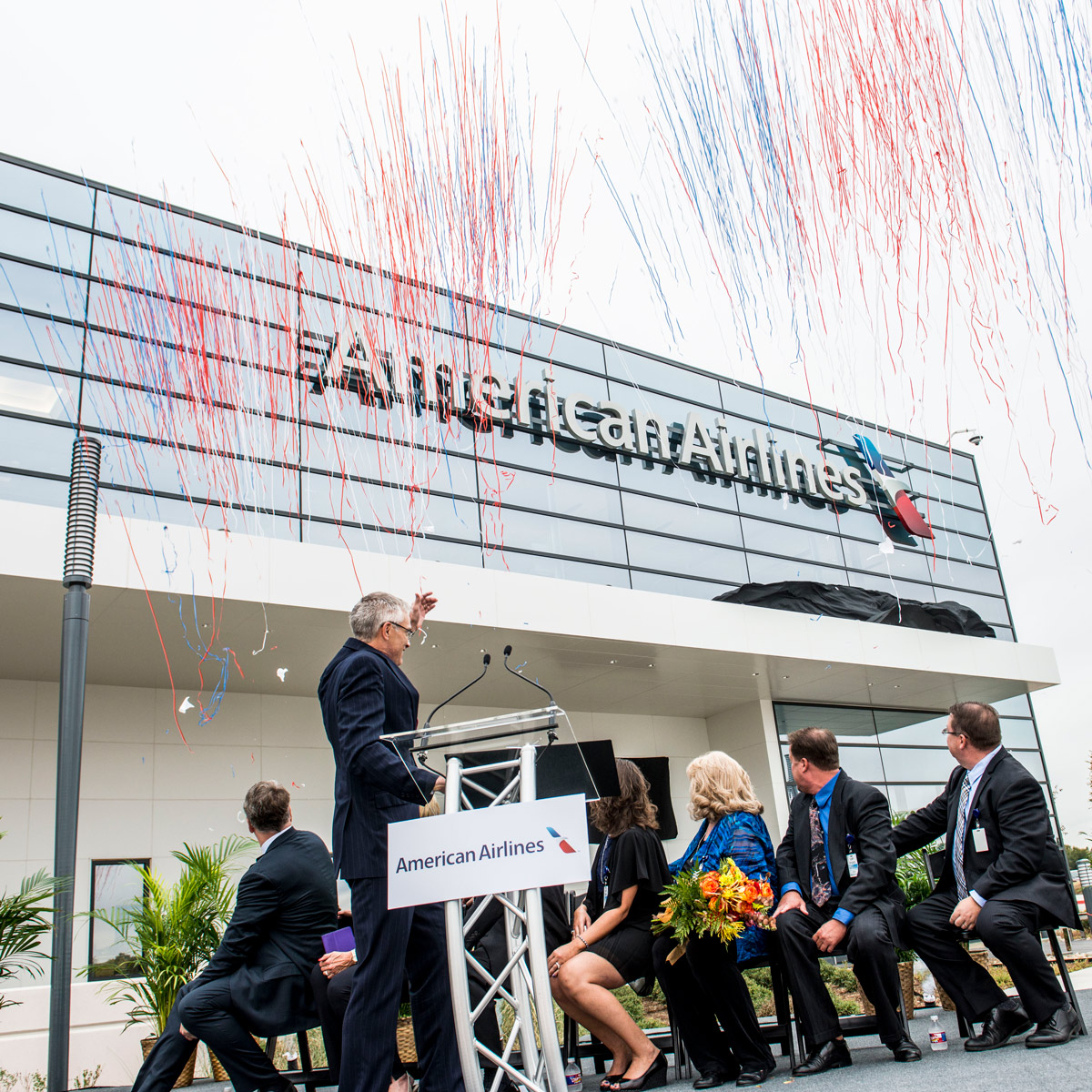
CEO Robert Isom (then COO) at the building’s ribbon cutting,
September 2015.
By 2024, one of the biggest technological changes at the IOC took place,
when American retired the 50-year-old FOS flight planning system in
favor of a modern, web-based tool called Flightkeys. This system is
easier to use and introduced a new alerting system that proactively
flags potential issues with flights. And, while Flightkeys still runs on
top of FOS, that will soon change as well.
As American looks to its next 100 years, the IOC is embarking on a major
technology modernization project. The Next-Gen operations platform will
change the way the IOC does business by retiring the old FOS mainframe
system and replacing it with modern tools that run on cloud computing
systems. The system will be oriented to support proactive operations
management — solving issues before they arise — and will modernize
FOS-based functions such as crew scheduling, takeoff and landing
performance calculation and weight and balance. It will be a sea change
in how American’s operation does business — and a win for its customers
— as the airline moves Forever Forward℠ and builds even
more resilience for the next hundred years.
Today’s American Airlines is the result of several heritage carriers
that have come and gone over the years. Here’s a look at where their
operations centers were located, the precursor to today’s IOC.
| Carrier |
Location |
| US Airways |
Pittsburgh |
| America West |
Phoenix |
| TWA |
JFK Airport (JFK) and St. Louis |
| Allegheny Airlines |
Pittsburgh |
| Piedmont Airlines |
Winston-Salem, North Carolina |
| Air Cal |
Orange County, California |
| Reno Air |
Reno, Nevada |
| PSA |
San Diego Airport (SAN) |
| Trump Shuttle |
LaGuardia Airport (LGA) |